
Transcript
Announcer:
Welcome to CME on ReachMD. This episode is part of our MinuteCE curriculum. Prior to beginning the activity, please be sure to review the faculty and commercial support disclosure statements as well as the learning objectives.
Dr. Lopes:
Hello. This is CME on ReachMD, and I'm Dr. Renato Lopes. Here with me today is Dr. Ander Cohen. Welcome, great to have you here.
Dr. Cohen:
Thank you, Renato. A pleasure to join you and discuss an interesting case of venous thrombosis in a patient with obesity.
Dr. Lopes:
Great. This is a challenging group of patients, and I can't wait to hear the case.
Dr. Cohen:
Well, it's a very common group that, also, as we often discuss. We know that, for instance in the UK, about two-thirds of adult males over 60 are overweight, and about one-third are obese. And I'm sure it's very similar in the Americas.
So today I’d like to discuss a 56-year-old woman who presented with progressive shortness of breath. She had a CTPA which showed bilateral lobar PEs and she starts on anticoagulation. But when she’s worked up, no causes are found apart from the fact that she has significant obesity with a BMI of greater than 44. So the question was raised, what anticoagulants should you use?
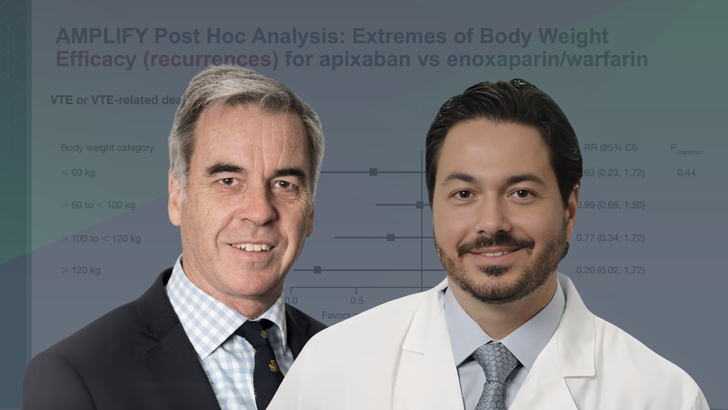
And I think that in the choice of anticoagulants, we need effective anticoagulants, but one of the most important things for patient compliance and patient safety is the bleeding profile. And if we look at the clinical trials for a start, we can see that in the AMPLIFY study with apixaban, a sub-analysis looking at weight showed that efficacy is maintained whether they’re low body weight, normal body weight, or high body weight, or even over 120 kg. But when we look at safety, there’s no effect on safety, whether you're low body weight or high body weight. And we see a superior safety profile with reduced clinically relevant bleeding with apixaban.
Now, that's all very well in clinical trials, but more recently, we've done some real-world evidence data looking at literally hundreds of thousands of patients with obesity in the United States and also shown significant advantages for the DOACs and, in particular, apixaban in patients who are obese or morbidly obese. So that’s really my starting point, Renato. I think that we’ve had recommendations one way or the other about using DOACs in obese patients, but it's very clear now that they're the treatment of choice in my view. But I’d be interested to get your thoughts.
Dr. Lopes:
So that's a great point, and I think you're right. At the beginning of the trials with DOACs, both in the atrial fibrillation arena but also in the VTE arena, we’re not so certain about the efficacy and safety of DOACs in the patients at the higher BMIs. But I think with overall data and sub-analyses from these trials, and also, as you well pointed out, with some real-world evidence, it reassured us that DOACs seems to be a better option for patients, for example, at least obesity Stage 3, greater than 40 of BMI. I think the challenge becomes when we start talking about much higher BMIs like 50 or 60. That, I think, we don’t have a lot of data in either direction. I don't think we also have data on warfarin or even on low-molecular-weight heparin for those extremes of body weight. But I think, overall, up to 140 kg and greater than 40 of BMI or up to 50, I think we have some reasonable data to support the efficacy and safety of the NOACs. Would you agree?
Dr. Cohen:
Yeah, I fully agree. And I think, also, that even in the patients up to 200 kg, we’ve seen in some of the data we've published on exposure, that there's still good exposure to DOACs in the standard doses to those high body weight patients. So I think you’re right; we need more information. But I can reassure my colleagues that we have good data, 140, 150 kg, lots of data. And that's the majority of overweight patients.
Dr. Lopes:
Correct. And the good news with the VTE population is that, on average, they are younger than the AFib population, so there is probably, in general, with a little bit lower than elderly patients.
Dr. Cohen:
Little bit lower in the long term, you're quite right. Yeah.
Well, thank you very much, Renato, and thanks to everyone for tuning in, and I look forward to seeing you at another meeting.
Dr. Lopes:
Thank you so much. Thanks everyone for listening.
Announcer:
You have been listening to CME on ReachMD. This activity is provided by TotalCME and is part of our MinuteCE curriculum. To receive your free CME credit, or to download this activity, go to ReachMD.com/CME. Thank you for listening.